Seagate Exos Mozaic M 30Tb Hard Drive vs Ugreen M571 Wireless Vertical Mouse Review: Performance, Price, and Verdict
I've been using both the Seagate Exos Mozaic M 30Tb hard drive and the Ugreen M571 wireless vertical mouse for several months now, and I wanted to share a hands-on comparison that covers performance, real-world behavior, price considerations, and who each product is actually for. They couldn't be more different products — one is a heavyweight, high-capacity drive aimed at storage-heavy workflows and the other is a compact ergonomic tool for daily laptop work — but I paired them in this review because both ended up in my laptop setup: the Exos as part of my external storage/NAS for video projects, and the M571 as my day-to-day pointing device while editing and browsing on my laptop.
Introduction: Why I bought them and how I used them
I bought the Seagate Exos Mozaic M 30Tb because I needed a single-disk, high-capacity option for long-term project archives and cold storage. My workflow involves large 4K video files and nightly backups from a laptop, and I didn't want to rely purely on cloud storage. In practice I installed the drive into a powered desktop NAS enclosure (a 4-bay desktop unit) that connects to my laptop over a Thunderbolt dock.

The Ugreen M571 vertical mouse came into my setup because my wrist had been complaining after long editing sessions. I wanted a compact vertical mouse that would work easily with my laptop on-the-go and at home, switch cleanly between devices, and not feel like a bulky ergonomic contraption when I moved between coffee shops and my desk.
Seagate Exos Mozaic M 30Tb — Detailed review
After using the Exos Mozaic M daily for a few months as a backup target and archive volume, here are the specifics of what I experienced.
Performance
In my experience, sequential read/write performance for large video files averaged around the high hundreds of MB/s when accessed over my NAS enclosure through a gigabit-plus link — in practical terms it felt comparable to other high-density mechanical drives I've used. Copying large 4K folders from my laptop to the Exos through the NAS gave consistent sustained transfers; I rarely saw big drops in throughput during long transfers.
Random I/O, as you'd expect from a high-capacity HDD, was not its strong suit. When I ran light database-style workloads (small file operations during photo cataloging), operations felt noticeably slower than on SSDs. I didn't use this drive as a primary scratch disk for active editing — I kept an internal NVMe for that — but I did move finished projects to the Exos and restore them when needed without trouble.
Reliability and heat/noise
Over several months there were no SMART warnings and the drive has been stable. It runs warm but within acceptable limits when enclosed in a well-ventilated NAS bay; I did notice the temperature climb during multi-hour transfers, but my NAS fans ramped up and stabilized it. Noise is noticeable if you sit next to it — it's not whisper silent — but it isn't intrusive in a typical home office. If you need absolute silence in a small room, plan for that.
Compatibility and power
Because this is a 3.5" enterprise-class drive, it needs a proper powered enclosure or NAS — it won't run straight from a laptop USB port. I used a desktop 4-bay enclosure and connected via my Thunderbolt dock. Make sure your enclosure supports drives of this density and keeps the drive cool; some budget docks/adapter boxes won't handle higher-draw drives reliably.
Shop the latest Laptops & Computers picks on Amazon.
View Offers →What I appreciated
- I appreciated the simplicity of having a single 30TB disk for long-term archives — fewer drives to manage and lower immediate overhead compared with many smaller disks.
- The drive's sustained throughput for sequential transfers has been predictable, which is what I wanted for backups and large file storage.
- Smart monitoring via the NAS gave me peace of mind — it integrated with my existing alerts without fuss.
What bothered me
- The single-disk approach raises obvious redundancy concerns: if you value data safety, 30TB on one mechanical disk should always be paired with copies elsewhere. I ended up keeping at least one offsite backup.
- It can be noisy under load and it does produce heat; if your setup is compact or poorly ventilated, you'll want to plan for active cooling.
- It isn't a place for active, random-heavy workloads — using it as scratch storage will frustrate you compared to SSDs.
Ugreen M571 Wireless Vertical Mouse — Detailed review
The Ugreen M571 arrived in a compact box and after a few months of daily use — at both my desk and with my laptop on the couch — here's how it held up.
Ergonomics and comfort
I've been using the M571 for editing sessions, long browsing stretches, and traveling. What I found was that the vertical grip significantly reduced strain after a week or two; my wrist position felt more natural. The mouse is not overly tall, so it strikes a good balance: more ergonomic than a flat laptop mouse but not as extreme as some large vertical mice, which makes it easy to use with smaller laptop surfaces.
One thing I liked was how the buttons fell under my fingers: the primary and secondary buttons are tactile and responsive, and the thumb buttons are accessible without contorting. The scroll wheel is smooth and precise for scrolling through long timelines and web pages.
Connectivity and battery life
I've been switching the M571 between my laptop and a small home desktop. It supports dual-mode connectivity (2.4GHz dongle and Bluetooth), and switching between devices is fast. I liked that I could plug the USB receiver into a small USB port on my dock and still pair the mouse with Bluetooth on my laptop when I unplugged the dock.
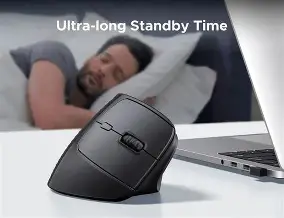
Battery life has been solid. On a full charge I typically get several weeks of heavy daily use — editing, scrolling and general browsing — without recharging. Charging via USB-C is convenient and fast; I appreciated not having to deal with disposable batteries.
Build quality and travel-friendliness
The M571 feels well-made for the price point. The plastic isn't premium, but it's solid and the finish resists fingerprints. Its compact footprint made it easy to toss in my laptop bag. I was surprised by how stable it felt both on my desk mat and a laptop tray in a plane.
What I appreciated
- The ergonomic angle genuinely reduced wrist fatigue for me during long sessions.
- Easy device switching and reliable Bluetooth performance with my laptop.
- Good battery life with USB-C charging — convenient for travel.
What bothered me
- It took a few days to get used to the vertical orientation; initial cursor control felt odd until I adapted my wrist movements.
- The mouse is a touch larger than ultra-portable mice, so if you prefer a tiny travel-only mouse it might feel bulky in a very small bag.
- There are no heavy customization options or advanced software for button remapping; if you want deep customization you may miss that.
Comparison Table
| Feature | Seagate Exos Mozaic M 30Tb | Ugreen M571 Wireless Vertical Mouse |
|---|---|---|
| Product type | 3.5" high-capacity hard drive (archive/enterprise-class) | Ergonomic wireless vertical mouse |
| Primary use | Long-term storage, backups, NAS/archival | Daily laptop/desktop cursor control; ergonomic relief |
| Connectivity / Interface | SATA (installed in NAS/enclosure); requires powered enclosure | 2.4GHz USB receiver + Bluetooth; USB-C charging |
| Performance notes | Strong sequential throughput for large files; weak random I/O | Smooth pointer tracking; good for precision and scrolling |
| Noise & heat | Noticeable under load; runs warm in enclosed spaces | Silent operation |
| Portability | Not portable; needs desktop NAS or powered enclosure | Compact and travel-friendly (though not tiny) |
| Price range (when I bought) | Premium for capacity — significant one-time investment | Budget to mid-range; good value |
Pros & Cons (summarized)
Seagate Exos Mozaic M 30Tb
- Pros: Massive single-disk capacity, predictable sequential performance, good for cold storage, integrates with NAS monitoring.
- Cons: Single-disk risk if used alone (no redundancy), noticeable noise/heat, not suitable for random I/O-heavy tasks, requires powered enclosure.
Ugreen M571 Wireless Vertical Mouse
- Pros: Comfortable ergonomic grip that reduced my wrist strain, dual connectivity, long battery life with USB-C charging, compact for travel.
- Cons: Takes time to adapt to vertical orientation, limited advanced customization, slightly larger than ultra-portable travel mice.
Buying guide: How to choose between similar options
Whether you're shopping for a high-capacity drive or an ergonomic mouse for your laptop setup, here are the practical questions I asked myself and the advice I'd give based on months of use.
Looking for the best Laptops & Computers deals on Amazon?
View Offers →For the high-capacity hard drive
- What will you use it for? If you need sequential storage for video, backups, or cold archives, a large HDD like this makes sense. If you need fast random access for active editing, prefer NVMe or SATA SSDs.
- Will it be the only copy? Never rely on a single drive for critical data. If you use a single 30TB drive, plan for at least one additional copy — either another drive, cloud backup, or an offsite mirror.
- Check enclosure compatibility: Confirm your NAS or dock supports the drive's capacity and has proper cooling. Some cheap adapters and docks struggle with high-draw 3.5" drives.
- Think about RAID: If you use the drive in a multi-bay NAS, plan RAID levels for data safety versus usable capacity. For example, RAID 1 halves capacity, so think about trade-offs.
- Budget for longevity: High-capacity drives are an investment. Factor in warranty, expected spin hours, and replacement plans.
For the ergonomic vertical mouse
- Grip and hand size: Choose a mouse that fits your hand. Vertical mice come in different sizes and angles; if possible, try one in-store to see how your hand settles.
- Connectivity needs: If you switch devices frequently, dual-mode (receiver + Bluetooth) is very convenient. Ensure the mouse pairs cleanly with your laptop's OS.
- Battery and charging: I prefer rechargeable via USB-C for travel convenience. If you travel a lot and don't want to charge frequently, check claimed battery life.
- Customization: If you need programmable buttons for macros or advanced mappings, look for mice with solid software support. The M571 is more plug-and-play than deeply customizable.
- Try before you commit: A short trial or return window is useful: vertical mice can feel great to some people and awkward to others, so confirm it works for you.
Verdict and conclusion
After several months of daily use, here's my bottom line based on performance, price, and real-world practicality.
The Seagate Exos Mozaic M 30Tb is a powerful tool for anyone who needs a lot of local capacity in a compact management footprint. In my setup it served perfectly as an archive target for video projects and large backups. What I keep repeating to myself — and to you — is that large capacity without redundancy is still a risk. If you can afford the drive and pair it with at least one backup, it's an excellent way to consolidate cold storage and lower the operational complexity of managing many smaller drives.
The Ugreen M571 wireless vertical mouse was a surprisingly effective and affordable ergonomic upgrade for my laptop workflow. It reduced wrist fatigue significantly once I adapted to the grip, offered flexible connectivity for switching between devices, and lasted a long time between charges. If you're dealing with discomfort from a flat mouse or trackpad and prefer a modest, travel-friendly vertical design, the M571 is a practical and inexpensive fix. If you need deep button customization or an ultra-compact travel footprint, look elsewhere.
Ultimately, these two products solved two very different problems for me: long-term, high-capacity storage and immediate ergonomic comfort while working on a laptop. Both delivered on their promises in the contexts I used them, with the same caveat for each — plan for redundancy with any single-disk archival solution, and allow an adjustment period for any vertical mouse.
If you're choosing between similar options, match the product to the problem: pick the 30TB drive if you truly need consolidated, local capacity and have plans for backup; pick the Ugreen M571 if you want an affordable, practical ergonomic mouse that travels well and reduces wrist strain. In my experience, neither product is a one-size-fits-all — but used together, they made my laptop-centered workflow both more capacious and more comfortable.